
Small Patio Garden Ideas: Transform Limited Space into a Lush Green Escape
Updated: Aug 3

Small patio garden ideas focus on maximizing limited space using vertical designs, compact containers, and low-maintenance plants. The most effective approach combines wall-mounted and hanging planters to free up floor space, a tiered arrangement to add height and depth, and a tight, well-chosen plant palette rather than an overcrowded one. With the right setup, even a balcony-sized patio can become a relaxing, productive garden.
If you think your space is too small to garden, think again. A compact patio is often easier to manage than a full backyard, with less watering to track, tighter control over sunlight and soil, and a lower upfront cost. At Austram, we've manufactured garden products since 1981 and have seen the smallest patios become the most rewarding gardens with the right tools and a smart layout. Here's how to do it.
Why Small Patio Gardening Works Better Than You Think
Many beginners assume gardening requires a large backyard. In practice, smaller spaces are easier to manage, cost less to set up, and let you focus on quality over quantity. A small patio garden gives you more control over watering, sunlight exposure, and plant arrangement, and that control tends to produce better results over time.
The constraint is also a design advantage. A small space forces clear decisions: one focal point instead of five, a considered plant palette instead of an impulse collection, vertical layers instead of sprawl. Those constraints are exactly what professional designers use to make compact spaces feel intentional and abundant rather than cluttered.
How to Start a Small Patio Garden Successfully

Before buying a single plant or container, understand your space. Two factors determine almost everything that follows: how much light you get, and how you'll use the vertical and floor area you have.
Assess Your Sunlight Honestly
Every patio is different. Some receive full sun; others sit in shade for most of the day. Spend a day noting how many hours of direct sunlight your patio actually gets, where the light falls, and how that changes from morning to afternoon. This single observation prevents the most common cause of patio garden failure: putting a sun-loving plant in a shaded corner, or a shade plant in blazing afternoon heat.
A useful benchmark is the three-hour threshold. Plants labeled "partial sun" or "partial shade" generally need at least three hours of direct sunlight per day to perform well. If a spot gets less than three hours of direct light, choose shade-tolerant plants such as ferns, hostas, or begonias. If it gets six or more hours, the full range of sun-loving herbs, vegetables, and flowering plants opens up.
Map Your Floor and Wall Space
Small patios have more growing space than they appear to; most of it is vertical. Before deciding on containers, take stock of: available floor area for standing pots, wall or fence space for mounted planters, railing space for hanging displays, and any overhead structure (a pergola beam, a hook, a bracket) that could support hanging baskets. A patio that looks full at floor level often has generous unused space above waist height.
Also note wind exposure. Balconies and rooftop patios can be surprisingly windy, which dries out containers faster and can topple tall, top-heavy pots. In exposed spots, favor lower, wider containers and wind-tolerant plants, or position taller plantings against a sheltering wall.
Design Tricks That Make a Small Patio Feel Larger
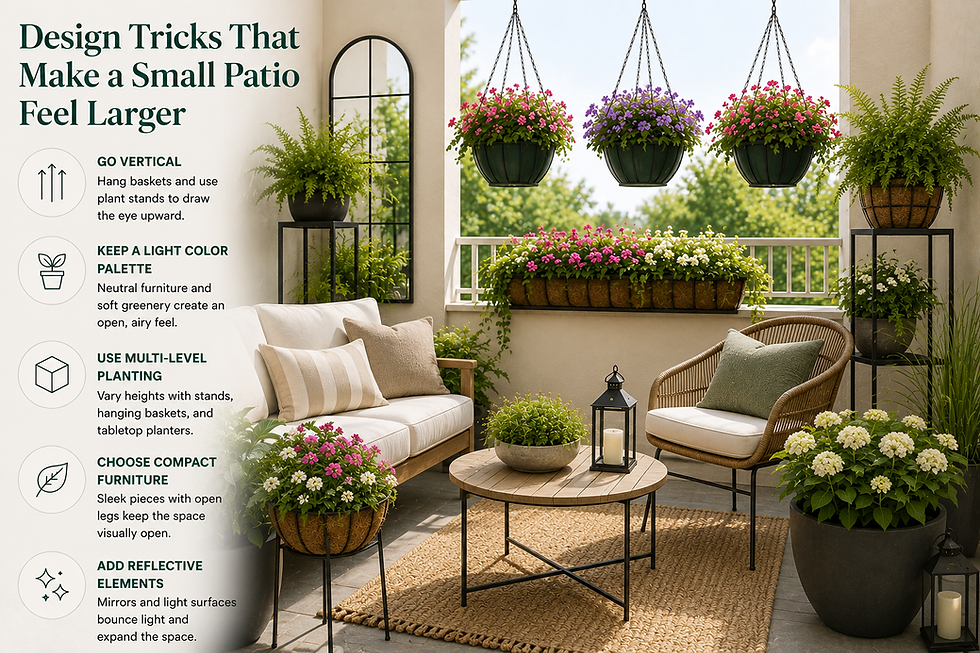
The best small-patio designs use a handful of visual techniques that professional garden designers rely on to make compact spaces feel more generous. None of them require more square footage, just smarter use of what you have.
Grow upward, not outward. Vertical layering is the single most effective small-space technique. Drawing the eye upward with wall planters, hanging baskets, tiered stands, and climbing plants makes a patio feel fuller and taller while keeping the floor clear for seating and movement.
Use a light, cohesive color palette. Light-colored walls, containers, and furniture reflect light, making a space feel more open. A tight, repeated color story, rather than one of every color, reads as calm and deliberate, which makes a small space feel larger.
Create depth with a diagonal. Arranging pavers, a rug, or planting beds on a 45-degree diagonal to the walls emphasizes the longest line in the space and tricks the eye into perceiving more depth than a straight, grid-aligned layout.
Add a mirror. An outdoor-rated mirror mounted on a fence or wall reflects greenery and light, effectively doubling the visual sense of space. Position it to reflect a planted area rather than a blank wall or a direct sightline into the home.
Build a foliage framework first. Establish structure with interesting foliage and leaf textures before layering in flowers. A patio anchored by strong greenery looks lush year-round, and the flowers become accents rather than the whole show.
Choose one primary purpose. The most successful small patios commit to a main function, a dining spot, a reading nook, or a productive herb garden, rather than trying to be everything at once. A clear purpose prevents the cluttered, half-finished feeling that comes from cramming too many uses into a tight footprint.
Best Small Patio Garden Ideas That Actually Work

Instead of overcrowding your patio, focus on strategic ideas that earn their place. Each of the following maximizes growing capacity without consuming precious floor space.
Vertical Gardening for Space Efficiency
Vertical gardening is the smartest way to grow more plants without taking up floor area. Wall-mounted planters, hanging baskets, and climbing plants on trellises let you build a green wall that doubles as living privacy screening.
For wall-mounted growing, Austram's Venetian Wall Planter (14" and 16") and Venetian Wall Trough (24", 30", and 36") mount directly to a wall or fence, turning vertical surface into planting space. For hanging displays, Euro Brackets (available in 12", 18", and 24") extend from a wall to hold hanging baskets clear of the floor. Pair them with a Cone Hanging Basket, Spanish Hanging Basket (12" and 14"), or Queen Anne Parasol Hanging Planter for a display that sits at eye level where it's both visible and easy to water.
Tiered Stands for Height and Depth
A tiered plant stand creates height variation that makes a small patio garden look fuller and more established than a flat arrangement of pots. Austram's Alexis Tall Stand with Coco Basket (available in 10" and 12") combines a raised stand with a coco-lined basket, adding a vertical accent in a compact footprint, ideal for a corner or beside a doorway where floor space is tight but vertical space is free.
Climbing Plants on Compact Supports
Climbing plants deliver a lot of greenery for very little floor space. A single obelisk or trellis supports vines that grow upward rather than outward. Austram's Exuma Obelisk (48" and 54" Matte Black) and Harbor Obelisk (Matte Bronze) provide an elegant vertical support for sweet peas, morning glory, nasturtiums, or clematis. For tropical vining houseplants that summer outdoors- pothos, philodendron, monstera- Coco Poles (24" through 60") give aerial roots a natural substrate to climb.
Compact Containers Built for Small Spaces
When floor space is limited, container proportions matter. Austram's ProGro Petite planter line, available in Hexagon, Round, Square, and Rectangular shapes, is designed specifically for compact planting: herbs, compact flowers, succulents, and small ornamentals. Their smaller footprint lets you fit more variety along a railing, windowsill, or narrow ledge without crowding.
Mobility: Chase the Sun and Reconfigure at Will
One of the most practical small-patio solutions is the ability to move heavy pots without strain. Austram's Lotus Plant Caddy (12" and 14") is a rolling steel-frame caddy on wheels that supports up to 200 pounds, protects patio flooring, and reduces the lifting strain of repositioning planted containers.
For a small patio, a rolling caddy does double duty. It lets you follow the sun through the season, moving a container into the light as the sun's angle shifts, and it lets you reconfigure the space on demand: roll a group of plants together to create a temporary privacy screen or a divider for a reading nook, then move them back. This mobility is especially valuable for renters, who benefit from a fully rearrangeable garden that requires no permanent installation.
No permanent installation: everything is freestanding, mounted with removable brackets, or on wheels. |
Lotus Plant Caddy (200 lb capacity) moves and reconfigures heavy pots without damage to flooring. |
ProGro Petite planters, compact footprint, easy to take with you when you move. |
Hanging baskets on removable Euro Brackets, vertical growing without drilling into walls you don't own (where a removable mount allows). |
Everything scales: start with three pots, expand as you learn your space. |
Choosing the Right Containers and Liners

Containers are the backbone of any small patio garden, and two choices determine how well they perform: weight and drainage.
Heavy soil in large ceramic or concrete pots makes a patio difficult to manage and can exceed the weight limits of balconies and rooftops. Combining a lighter potting mix with quality coco fiber liners reduces weight while improving moisture management, which is especially helpful for renters and in elevated spaces with structural limits.
Austram's ProGro Coco Fiber Liners are made from natural coconut coir. They retain moisture evenly throughout the root zone, promote proper drainage to prevent root rot, and maintain their structure throughout the growing season. In hanging baskets and wall planters where drying out fast is the main challenge on a sunny patio, a quality liner is the difference between a display that thrives all summer and one that struggles by midseason.
For guidance on lining baskets and matching container size to plants:
If you want a decorative, freeze-resistant container that stays outdoors year-round, stone-composite planters are worth considering for a small patio's statement piece:
Best Plants for a Small Patio Garden
The right plant choice depends on your light, your climate, and how much time you want to spend on maintenance. The table below covers reliable performers for compact spaces, organized by growing conditions.
Plant Type | Sun Requirement | Maintenance | Best Use on a Patio |
Herbs (basil, thyme, mint) | Full sun (6+ hrs) | Low | Cooking, fragrance, compact railing pots |
Succulents | Partial to full sun | Very low | Decorative, drought-tolerant, small pots |
Cherry tomatoes | Full sun (6+ hrs) | Medium | Food production in a deep container or grow bag |
Ferns | Shade / partial shade | Low | Cooler, shaded corners and north-facing patios |
Hostas | Shade / partial shade | Low | Foliage structure in low-light spots |
Trailing flowers (bacopa, trailing verbena) | Sun to partial sun | Medium | Hanging baskets and wall planters, cascade effect |
Compact flowering (petunias, begonias) | Varies by type | Medium | Color at eye level in hanging or wall displays |
Climbers (sweet pea, clematis, morning glory) | Full to partial sun | Medium | Vertical interest on an obelisk or trellis |
Group plants with similar water and light needs together. This makes watering more efficient and prevents the common problem of one plant being overwatered while its neighbor stays thirsty.
Adding Privacy to a Small Patio

Privacy is one of the most requested features for small patios, balconies, and courtyards, and plants solve it more elegantly than solid walls, which can make a small space feel boxed in.
Columnar plants: Where a wide shrub won't fit, narrow columnar plants provide height and screening without consuming floor space. They deliver privacy in the vertical dimension where you have room to spare.
Climbers on a trellis or obelisk: A vertical support planted with a fast climber creates a living green screen in a single season. Jasmine and annual vines are well-behaved options that add fragrance alongside screening.
Grouped containers as a movable screen: A cluster of tall planted containers, easily arranged and rearranged on a rolling plant caddy, creates a flexible privacy screen or room divider that you can reposition whenever you need to.
Hanging and trailing plants: Cascading plants from an overhead structure or high wall planters create a soft, layered curtain of foliage that screens sightlines from above without blocking light entirely.
Lighting a Small Patio Garden for Evening Use

Good lighting doubles the usable hours of a small patio and dramatically changes its atmosphere after dark. Because a small space needs less light to fill, patio lighting is one of the highest-impact, lowest-cost upgrades available.
Layer your lighting rather than relying on a single bright source. Warm-toned string lights create an instant cozy ambiance overhead. Solar-powered lanterns and stake lights need no wiring and recharge during the day- ideal for renters and spaces without an outdoor outlet. Uplighting a single specimen plant or small tree creates visual depth and a striking focal point after dark. Warm light consistently reads as more relaxing than bright white, and a well-lit corner draws the eye and makes the whole space feel larger and more inviting in the evening.
Adding a Water Feature or Focal Point

Austram's Abaco Bird Bath, made from the same freeze-resistant 65% stone / 35% recycled plastic composite as the Vizcaya Collection, provides a durable, year-round water feature and focal point that also attracts birds and pollinators to an urban patio. A single well-chosen focal point anchors a small garden and gives the eye a natural resting place, which makes the overall design feel considered rather than scattered.
The 70/30 Rule: A Design Principle for Small Spaces
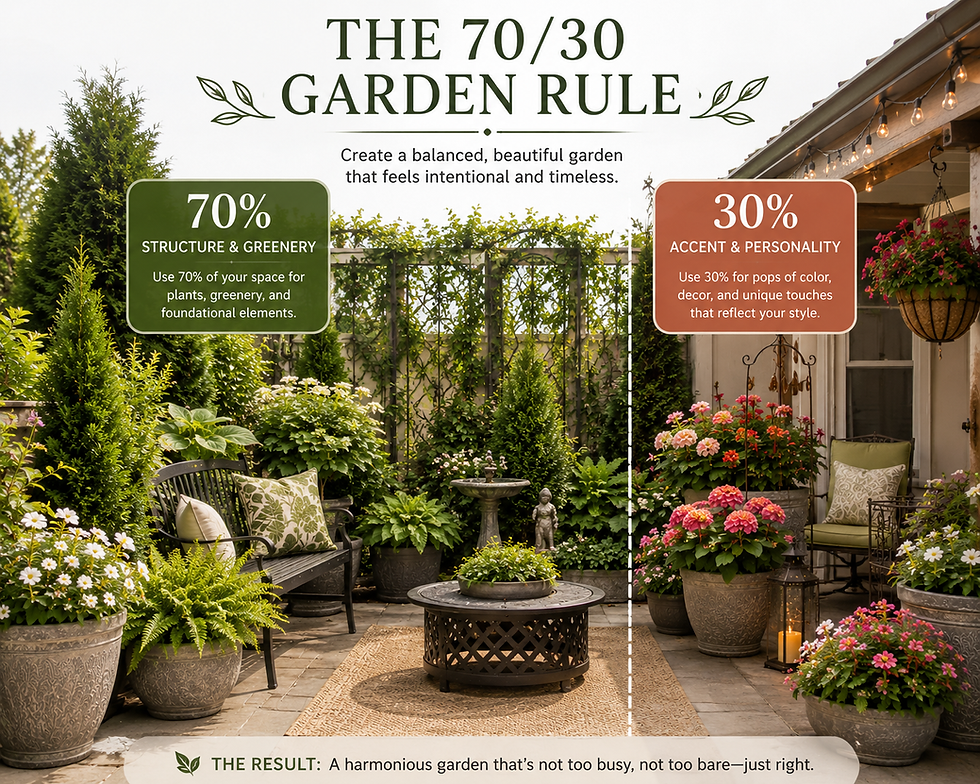
The 70/30 rule is a widely used garden design principle credited to renowned garden designer Piet Oudolf, who designed New York City's High Line. In its original form, it suggests dedicating roughly 70% of your planting to structural plants that provide visual interest across multiple seasons- strong foliage, form, and texture that hold up through autumn- and 30% to seasonal "filler" plants that supply bursts of color and bloom.
On a small patio, this principle is especially useful. Because every plant is highly visible, a space planted entirely with short-lived seasonal color can look bare and lifeless once those plants fade. Anchoring 70% of your containers with structural, long-interest plants, evergreen herbs, ornamental grasses, and compact foliage shrubs keeps the patio looking full year-round, while the remaining 30% of seasonal flowers gives you room to experiment and refresh the look without redoing the whole space.
A well-known variation of the 70/30 rule applies it to native planting: aiming for roughly 70% native or well-adapted plants and 30% non-native ornamentals. This approach supports local pollinators and tends to be lower-maintenance, since native plants are naturally suited to your climate.
Common Mistakes to Avoid in Small Patio Gardening
Overcrowding plants. Cramming too many plants into a small space reduces airflow and light, which leads to weak growth and more pests. Give each plant room to breathe; a smaller number of healthy plants always looks better than a crowded, struggling collection.
Ignoring drainage. Without proper drainage, container plants quickly develop root rot. Use containers with drainage holes and quality liners, and never let pots sit in standing water in a saucer.
Choosing the wrong plants for your light. A sun-loving plant will not survive in a shaded corner, and a shade plant will scorch in full afternoon sun. Match every plant to the light your patio actually provides, not the light you wish it had.
Overwatering. The single most common beginner mistake. More water does not mean healthier plants; it usually means root rot. Water when the top inch of soil is dry, not on a fixed daily schedule.
Forgetting the vertical dimension. Treating a small patio as floor-space-only wastes most of its potential. Walls, railings, and overhead structures are all growing space.
Skipping wind protection on balconies. Elevated and rooftop patios dry out fast and can topple top-heavy pots. Account for wind in your plant and container choices.
Small Patio Setup Comparison
Different setups suit different spaces, budgets, and experience levels. This comparison helps identify the right starting point for your patio.
Setup Type | Space Needed | Cost | Difficulty | Best For Beginners |
Basic containers | Low | Low | Easy | Yes, the simplest starting point |
Hanging garden | Low | Low | Easy | Yes- frees floor space |
Vertical / wall garden | Medium | Medium | Moderate | Yes, high impact, learnable |
Tiered stand display | Low | Medium | Easy | Yes, instant height and depth |
Raised beds | High | Medium | Moderate | Limitedneeds more space |
Practical Tips to Maximize Your Small Patio Garden
Rotate plants periodically so all sides receive even sunlight and grow symmetrically.
Use self-watering containers or water-retaining granules to reduce maintenance on hot days.
Group plants with similar water and light needs together for efficient care.
Keep tools organized in a compact vertical rack or a bench with storage to save floor space.
Start small and expand gradually; three well-chosen plants you can maintain beat twenty you can't.
Follow the sun-safety habit: avoid heavy gardening work between 11 a.m. and 2 p.m. in summer, when UV is most intense.
A practical starting point: begin with three herb plants in coco-lined containers on a sunny railing. Once you understand how your space behaves through a season, where the light falls, how fast things dry out, and what thrives, expand into vertical gardening and a wider plant palette with confidence.
How Austram Helps You Build a Better Patio Garden
Choosing the right supplier makes a real difference in a small garden, where every product has to earn its place. Austram manufactures durable, space-conscious garden products designed for real growing conditions, from ProGro coco fiber liners and Petite planters to wall planters, obelisks, tiered stands, and rolling plant caddies.
For larger quantities or trade supply for a landscaping business, a property, or a retail garden center, Austram products are available through an authorized wholesale distributor network:
Frequently Asked Questions
How do you have a garden on a small patio?
The best way to garden on a small patio is to use vertical space, compact containers, and low-maintenance plants matched to your light. Start by assessing how many hours of direct sun your patio gets, then choose plants suited to those conditions. Use wall planters, hanging baskets, and tiered stands to grow upward and keep the floor clear. Keep the layout simple and avoid overcrowding.
Even a balcony-sized patio can support herbs, flowers, and compact vegetables when you grow vertically and choose the right containers. Begin with three or four plants, learn how your space behaves through a season, and expand from there.
What is the 70/30 rule in gardening?
The 70/30 rule, credited to celebrated garden designer Piet Oudolf, suggests dedicating about 70% of your planting to structural plants that provide visual interest across multiple seasons- strong foliage, form, and texture- and 30% to seasonal "filler" plants that supply short-lived bursts of color. The 70% keeps the garden looking full and cohesive year-round, while the 30% gives room to experiment. A common variation applies the ratio to native planting: roughly 70% native or well-adapted plants and 30% non-native ornamentals, which supports pollinators and lowers maintenance. On a small patio, where every plant is highly visible, the structural 70% is what keeps the space from looking bare when seasonal flowers fade.
What is the 3-hour rule in gardening?
The "3-hour rule" most commonly refers to a sun-safety guideline: avoid gardening between 11 a.m. and 2 p.m. during summer, the roughly three-hour window when the sun and UV are most intense. Popularized by UK gardener Shannen Goodwin, it protects gardeners from sun damage and heat stress, and it also benefits plants, since watering, pruning, and transplanting are all better done in the cooler morning or evening.
A separate use of "three hours" describes a plant's light needs: partial-sun and partial-shade plants generally require at least three hours of direct sunlight per day to grow well. Both meanings are useful for patio gardeners; one protects you, the other guides plant selection for your specific light conditions.
What can you do with a small patio garden?
A small patio garden can be a herb and vegetable source, a flowering display for color and pollinators, a private green retreat, or all three in rotation. Grow herbs for cooking, add trailing flowers in hanging baskets for color, use climbers on an obelisk for vertical interest, and add a small water feature or seating to make it a place to relax.
The key is choosing one primary purpose so the space feels intentional rather than crowded. A patio designed around a clear main function- dining, growing, or relaxing- consistently works better than one trying to do everything in a tight footprint.
What is the most common mistake first-time gardeners make?
The two most common mistakes are overwatering and overcrowding. Many beginners assume more water means healthier plants, but overwatering is a leading cause of root rot. Overcrowding, squeezing in too many plants, reduces airflow and light, weakening every plant in the arrangement and inviting pests.
Both are easy to avoid: water only when the top inch of soil is dry, and give each plant enough space to reach its mature size. On a small patio, restraint in plant count almost always produces a healthier, better-looking garden than cramming in as many plants as possible.
What are some low-maintenance small patio garden ideas?
The lowest-maintenance small patio setups use succulents, hardy herbs, and self-watering or coco-lined containers. Choose drought-tolerant plants, group them by water and light needs, and use quality liners that retain moisture evenly to reduce watering frequency. Native and well-adapted plants require the least ongoing care because they're suited to your local climate.
Vertical gardens and hanging baskets can also lower maintenance by improving drainage and airflow, which reduces disease. Add a rolling plant caddy so you can move heavy containers without strain, and the whole garden becomes easier to maintain and rearrange as the seasons change.
Final Thoughts on Small Patio Garden Ideas
Creating a beautiful, productive patio garden doesn't require a large space. It requires smart design: growing vertically, choosing compact containers and the right liners, matching plants to your light, and committing to one clear purpose for the space. Anchor the planting with structural greenery, add seasonal color as an accent, and use height, mirrors, and light to make the space feel larger than it is.
With quality materials and a few practical strategies, even the smallest patio becomes a relaxing green escape- one that grows richer and more established every season. Start small, stay consistent, avoid the common mistakes, and your patio garden won't just grow. It'll thrive.
For more on the trends shaping outdoor spaces this year: Top garden trends of 2026
ProGro Coco Fiber Liners → austram.com/progro-coco-fiber-liners |
ProGro Petite Planters — Hexagon, Round, Square, Rectangular (compact footprint) |
Venetian Wall Planter (14", 16") and Wall Trough (24", 30", 36") — vertical growing |
Euro Brackets (12", 18", 24") for hanging baskets |
Alexis Tall Stand with Coco Basket (10", 12") — tiered height |
Lotus Plant Caddy (12", 14") — rolling, 200 lb capacity, protects flooring |
Exuma / Harbor Obelisk and Coco Poles — vertical support for climbers |
Abaco Bird Bath — compact, freeze-resistant water feature |
Available through Austram wholesale distributors nationwide. |


Comments