
What Are Vizcaya Pots?

Vizcaya pots are decorative garden planters made from a composite of 65% stone and 35% recycled plastic. That specific material combination gives them the visual weight and textured finish of natural stone while remaining lightweight, freeze-resistant, and equipped with built-in drainage for indoor and outdoor use year-round. They are manufactured by Austram and available through authorized wholesale distributors across the United States.
This guide covers exactly what Vizcaya pots are made of, how the composite construction compares to traditional planter materials, the full product line with verified dimensions, what plants grow best in them, and how to care for them.
What are Vizcaya Pots Made Of?

The material composition of Vizcaya pots is the starting point for understanding everything else about them. The 65% stone content is what gives them their visual texture, density, and authentic stone-like appearance. The 35% recycled plastic content is what makes them lightweight, non-porous, and freeze-resistant.
That combination is not accidental. Natural stone planters have visual authority but are heavy, expensive to ship, difficult to move, and prone to cracking during freeze-thaw cycles. Terracotta and ceramic planters are porous, which creates root aeration benefits but also makes them vulnerable to frost damage. Vizcaya pots are designed to deliver the appearance of the first category while providing the practical performance of the second.
The material is also non-porous. Water does not penetrate the walls, which means soil dries more slowly than in terracotta or unglazed ceramic, making it better for moisture-loving plants, and the primary reason the freeze-resistance works as it does.
65% stone content creates visual texture, density, and a stone-like appearance |
35% recycled plastic, lightweight, non-porous, flexible under temperature stress |
Extremely lightweight and durable relative to solid stone or concrete |
Built-in drainage holes on all models |
Crack resistant in freezing temperatures |
Why Vizcaya Pots Are Freeze-Resistant and Why Most Pots Aren't
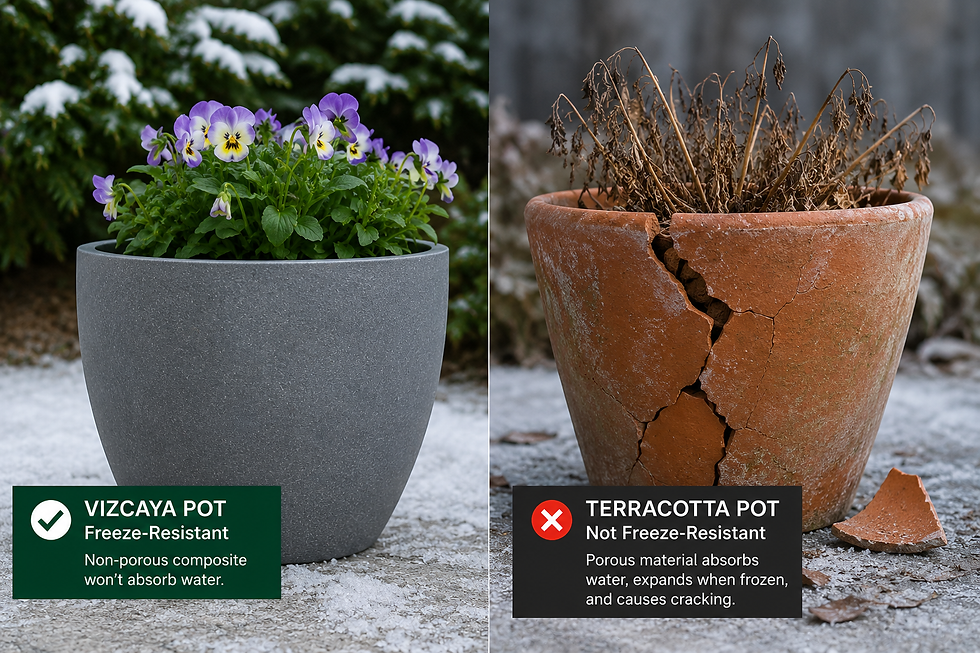
Freeze resistance is one of the most important practical properties in a planter for anyone gardening in the United States outside of the warmest climates. Understanding why some pots fail in winter helps explain exactly what makes Vizcaya pots different.
Terracotta and unglazed ceramic are porous; they absorb moisture through their walls during watering. When temperatures drop below freezing, that absorbed moisture expands as it turns to ice. The expansion force cracks the pot from the inside out. This is not a matter of pot quality or care; it is a material physics problem. Any porous pot that absorbs water will crack eventually in repeated freeze-thaw cycles, regardless of brand or price point.
Vizcaya pots are non-porous. The 65% stone / 35% recycled plastic composite does not absorb moisture through its walls. There is no water inside the pot wall to freeze. The pot wall itself is not under expansion stress when temperatures drop. This is why Vizcaya pots can remain outdoors year-round in climates with hard winters; the freeze-thaw mechanism that destroys terracotta and unglazed ceramic simply cannot occur.
The same non-porous construction also explains their weight advantage. Solid stone and concrete planters are heavy because the material is dense all the way through. The composite construction of Vizcaya pots achieves the visual density of stone with significantly less material mass, making them practical for patios, balconies, rooftop installations, and anywhere weight is a constraint.
Vizcaya Stone Composite vs. Other Planter Materials
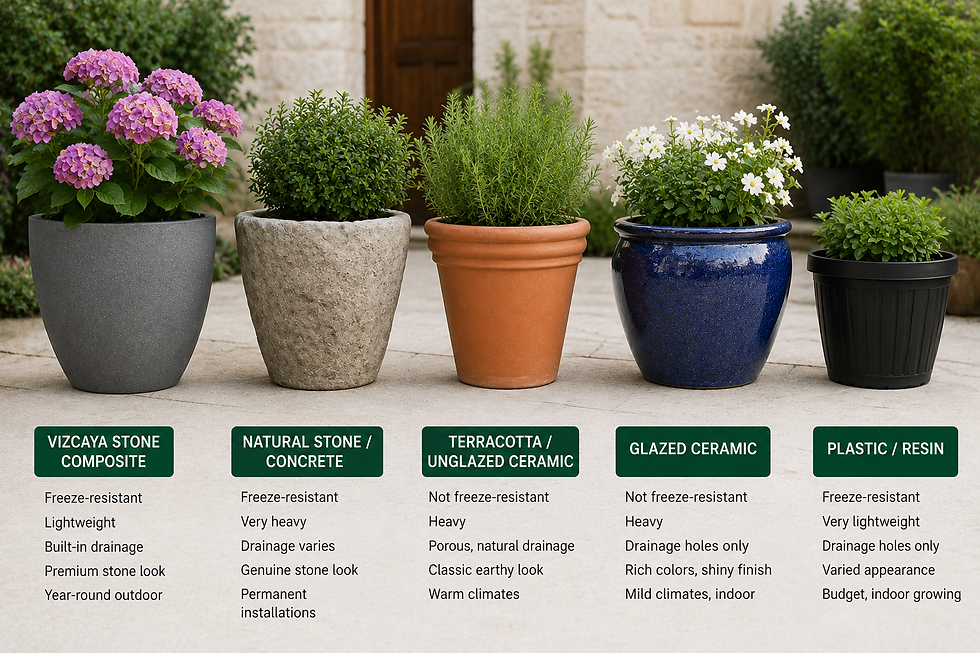
Understanding how stone composite compares to other common planter materials helps identify when Vizcaya pots are the right choice and when a different material might serve better.
Material | Freeze Resistant | Lightweight | Drainage | Appearance | Best For |
Stone composite (Vizcaya) | Yes | Yes, relative to stone | Built-in holes | Premium stone-like texture | Year-round outdoor, all climates |
Natural stone/concrete | Yes | No, very heavy | Variable | Genuine stone finish | Permanent installations, large budgets |
Terracotta / unglazed ceramic | No, cracks in frost | No | Through porous walls + holes | Classic earthy texture | Warm climates, succulents, cacti |
Glazed ceramic | No, vulnerable in hard frost | No | Drainage holes only | Rich colors, shiny finish | Mild climates, indoor, sheltered use |
Plastic/standard resin | Yes, most grades | Yes, very light | Drainage holes only | Variable: can look plastic | Budget, utilitarian, indoor growing |
Fiberglass | Yes | Yes | Drainage holes only | Highly customizable | Commercial, large-scale, custom work |
Stone composite, the Vizcaya category, occupies a specific position in this comparison: the visual and material quality of natural stone, with the weight and freeze resistance of composite materials. It is the appropriate choice when year-round outdoor performance, a premium stone-like appearance, and practical portability all matter simultaneously.
The limitation worth noting: the non-porous construction means soil retains moisture longer than in terracotta or unglazed ceramic. This is an advantage for moisture-loving tropicals, ferns, and flowering ornamentals. For plants that prefer sharp drainage- succulents, cacti, and Mediterranean herbs like lavender and rosemary- ensure an appropriately free-draining potting mix is used, and monitor watering frequency accordingly.
The Full Vizcaya Collection, All Models Verified from the 2025 Catalog

Vizcaya is a collection of six distinct planter forms, each available in multiple colors. All are made from the same 65% stone / 35% recycled plastic composite and carry the same freeze resistance and drainage specifications.
Model | Dimensions (L×W×H) | Available Colors | Suited For |
Vizcaya Pot | 12" × 9" × 11" | Anchor Grey, Rust, Black | Specimen plants, ornamental flowers, patio arrangements |
Vizcaya Planter | 11" × 11" × 9" | Anchor Grey | Compact shrubs, perennials, herbs |
Vizcaya Planter | 14" × 14" × 11" | Anchor Grey | Larger ornamentals, statement patio plantings |
Vizcaya Square Planter | 12" × 12" × 18" | Anchor Grey, Rust, Black | Tall-rooted plants, grasses, columnar shrubs |
Vizcaya Vase | 11" × 6" × 20" | Anchor Grey | Statement display, architectural interest, entryways |
Vizcaya Square Vase | 12" × 8" × 20" | Anchor Grey, Rust, Black | Tall specimens, formal garden settings |
A 53-piece Vizcaya Assortment is also available, covering all models and colors in a single wholesale order for retailers who want to display the full collection.
The Andros Urn and Abaco Bird Bat, part of Austram's wider decorative range, are made from the same 65% stone / 35% recycled plastic composite as the Vizcaya Collection, carrying the same freeze resistance, drainage, and weight properties. They are a natural complement to Vizcaya planters in both residential and commercial landscape settings.
The Name and Design Heritage

The name "Vizcaya" traces back to the Basque region of northern Spain. Vizcaya (Bizkaia in Basque) is the coastal province whose capital is Bilbao, known for its rugged landscape and distinctive architecture. The name reached Miami by an interesting route: the Vizcaya Museum and Gardens estate was named after Biscayne Bay, which was itself named after the Spanish province of Biscay (Vizcaya). In European tradition, Vizcayan and broader Mediterranean design became associated with formal stonework, decorative gardens, and enduring craftsmanship.
The Vizcaya Museum and Gardens in Miami is a National Historic Landmark, built between 1914 and 1922 as a winter estate for industrialist James Deering. Designed in an Italian Renaissance and Mediterranean revival style by architect Francis Burrall Hoffman with landscape design by Diego Suarez, the estate's formal Italian gardens are considered among the finest examples of European-inspired garden design in North America. Terraced stone balustrades, geometric parterres, formal hedging, and substantial stone planters define the aesthetic. Notably, the estate was built largely from reinforced concrete faced with local coral stone, giving the gardens their intentionally weathered appearance.
Austram's Vizcaya planters draw on that same design language: the textured stone finish, the substantial proportions, and the Anchor Grey and Rust colorways that reference both natural weathered stone and the warm, aged tones of Mediterranean architecture. The goal is not to reproduce a historical artifact but to make that design vocabulary practical and accessible, lightweight enough to move, durable enough to leave outdoors year-round, and priced for a commercial product rather than a bespoke commission.
Best Plants for Vizcaya Pots

The non-porous, moisture-retaining properties of stone composite make Vizcaya pots well suited for a specific set of plants. The following categories consistently perform well.
Best Suited, Moisture-Loving, and Statement Plants
Plant Type | Why It Works in a Vizcaya Pot |
Monstera | Becomes top-heavy as it matures, but the stability and depth of a Vizcaya Square Planter or larger model prevent tipping |
Palms | Deep root systems need container depth; a stable base is essential as the plant grows tall |
Fiddle leaf fig | Large foliage and vertical growth need an anchored, proportional container to avoid instability |
Ornamental grasses | Broad root spread benefits from the wider square planter models; they drain freely in composite |
Ferns and hostas | Prefer consistently moist soil. Non-porous composite retains moisture longer than terracotta |
Lavender | In the smaller Vizcaya Pot, add gritty, free-draining mix to compensate for non-porous walls |
Flowering shrubs | Statement outdoor planting; freeze resistance supports year-round positioning outdoors |
Topiary and boxwood | Formal clipped shapes suit the Vizcaya design language; a stable base is needed for wind resistance |
Citrus trees | Heavy feeders that thrive in larger containers; non-porous walls reduce root-zone moisture loss |
Potting Mix Guidance for Vizcaya Pots
Because Vizcaya pots are non-porous, soil moisture is retained longer than in terracotta equivalents. Use a quality container potting mix, not garden soil, which compacts in containers. For moisture-loving plants (ferns, tropicals, monstera), standard container mix works well. For plants that prefer drier conditions (lavender, succulents, herbs), amend the mix with 20–30% perlite to improve drainage and prevent moisture from sitting at the root zone between waterings.
For a full guide on matching container size to plant requirements:
Pairing Vizcaya Pots with ProGro Coco Fiber Liners
For gardeners using open wire baskets or wall planters alongside Vizcaya pots in the same display, Austram's ProGro Coco Fiber Liners provide the same philosophy applied to basket growing: quality materials, extended lifespan, and performance designed for how the product will actually be used.
ProGro Premium liners made from coconut coir with no glue or additives last approximately two full growing seasons and distribute moisture evenly across the root zone without the bird's nest effect that breaks down cheaper liners mid-season. For mixed displays that combine Vizcaya container plantings with hanging baskets or wall planters, ProGro liners maintain the same standard of presentation across the whole arrangement.
How to Clean and Care for Vizcaya Pots
One of the practical advantages of stone composite over terracotta and unglazed ceramic is the ease of cleaning. Because the material is non-porous, dirt, mineral deposits, and algae stay on the surface rather than penetrating the walls. This makes maintenance straightforward.
Routine cleaning: Wipe down with a damp cloth or rinse with a garden hose. For surface algae or mineral build-up from hard water, use a mild solution of dish soap and water with a soft brush. Rinse thoroughly. Do not use harsh chemical cleaners or abrasive scrubbers, which can damage the surface finish over time.
Winter storage: Vizcaya pots do not need to be brought indoors for winter. Their freeze resistance is the primary design advantage for gardeners in cold climates; they can remain planted and positioned outdoors through hard frosts and repeated freeze-thaw cycles. If relocating for the season, empty planted soil and store upright in a sheltered position to protect from wind knock-over rather than from cold.
Sealing: No sealing is required or recommended. The non-porous composite does not need external sealing for frost protection (unlike terracotta) or for aesthetic maintenance. The finish is integral to the material rather than applied to the surface.
Where Vizcaya Pots Work Best
The combination of stone appearance, freeze resistance, and relative lightness makes Vizcaya pots suited to settings where traditional stone or concrete planters would be impractical.
Patios and decks, lightweight relative to stone; repositionable seasonally or for events
Entryways and front doors with formal proportions and stone appearance suit entrance landscaping
Balconies and rooftop terraces' weight is a structural consideration; composite is significantly lighter than stone or concrete
Poolside non-porous construction resists chlorinated water splash; Rust and Anchor Grey colorways suit poolscape design
Commercial landscaping, hotels, restaurants, retail frontages, office campuses; freeze resistance and durability reduce replacement costs
Mixed indoor/outdoor displays can be used indoors with drainage trays; the same planter can move between settings seasonally
For wholesale or commercial supply of Vizcaya planters:
What Makes Vizcaya Pots Different from Standard Composite Planters

The composite planter category has grown significantly in recent years as manufacturers have refined the material formulations that give composite pots their stone-like appearance. Not all composite planters perform equally, and the differences are worth understanding before choosing.
Stone ratio matters. Vizcaya pots use a 65% stone content. Higher stone content produces a more authentic visual texture and greater surface density; the pot feels and looks more like stone rather than plastic with a stone-effect coating. Lower stone ratios can look convincing at a distance but betray themselves on closer inspection or on the shelf.
UV stability. Lower-quality composite planters can fade or become brittle with extended UV exposure. Austram's Vizcaya pots are designed for year-round outdoor placement. UV degradation is a key quality variable between product tiers. The Anchor Grey and Rust finishes are integral to the material, not surface coatings that chip or peel.
Drainage design. Built-in drainage holes across all Vizcaya models are a non-negotiable quality feature. A composite planter without drainage is a plant-health liability regardless of how good the exterior looks.
Frequently Asked Questions About Vizcaya Pots
What are Vizcaya pots made of?
Vizcaya pots are made from a composite of 65% stone and 35% recycled plastic. This specific material combination gives them the visual texture and density of natural stone while being significantly lighter, non-porous, and freeze-resistant. All Vizcaya models include built-in drainage holes and are manufactured by Austram.
The non-porous construction means water does not penetrate the pot wall, making it safe to leave outdoors through hard winters without cracking, and ensuring that dirt and algae sit on the surface rather than absorbing in, which makes cleaning straightforward.
Are Vizcaya pots freeze-resistant?
Yes. Vizcaya pots are specifically designed to resist freeze-thaw damage. Traditional porous planters (terracotta, unglazed ceramic) crack in freezing temperatures because moisture absorbed into the pot wall expands as it freezes. Vizcaya pots are non-porous; there is no moisture in the pot wall to freeze and expand, so the freeze-thaw cracking mechanism cannot occur.
They can be left outdoors year-round in all US climates, including those with hard winters. No winter storage or protection is needed.
What sizes do Vizcaya pots come in?
The Vizcaya Collection includes six models: the Vizcaya Pot (12"×9"×11"), the Vizcaya Planter in two sizes (11"×11"×9" and 14"×14"×11"), the Vizcaya Square Planter (12"×12"×18"), the Vizcaya Vase (11"×6"×20"), and the Vizcaya Square Vase (12"×8"×20"). All are available through Austram's authorized wholesale distributor network.
A 53-piece Vizcaya Assortment covering all models and colors is available for retailers wanting to display the full collection.
What colors do Vizcaya pots come in?
Vizcaya pots are available in three finishes: Anchor Grey, Rust, and Black. Anchor Grey is a contemporary stone tone that suits modern and transitional outdoor settings. Rust provides a warmer, aged-stone appearance suited to Mediterranean and rustic garden styles. Black offers a clean, architectural look for contemporary landscapes.
The Andros Urn and Abaco Bird Bath- part of the same composite material family- are also available in Weathered White, Creased Grey, Sea Blue, and Roman Green, expanding the color options for coordinated outdoor installations.
Are Vizcaya pots good for outdoor use?
Yes, outdoor use is the primary design application. The freeze-resistant construction, non-porous walls, weather-durable composite material, and built-in drainage holes are all features specifically engineered for year-round outdoor performance. They are suited for patios, entryways, poolside settings, balconies, and commercial landscaping.
They can also be used indoors with the addition of drainage trays. The same planter can move between indoor and outdoor settings seasonally, a flexibility that purely decorative pots designed only for indoor use cannot match.
What is the difference between Vizcaya pots and terracotta pots?
The core difference is material porosity. Terracotta is porous clay; it breathes, which benefits plant roots, but it also absorbs moisture into the wall, making it vulnerable to freeze-thaw cracking. In climates with frost, terracotta must be brought indoors for winter or risk cracking. Vizcaya pots are non-porous composite, no frost damage risk, no winter storage required.
Terracotta is the better choice for plants that need excellent root airflow and sharply draining conditions: succulents, cacti, lavender, and Mediterranean herbs. Vizcaya pots are the better choice for plants that tolerate or prefer consistent moisture, and for any outdoor setting where year-round installation without seasonal moving is the goal.
What is the meaning of "Vizcaya"?
"Vizcaya" is the Spanish name for a historic region in the Basque Country of northern Spain, the coastal province whose capital is Bilbao. The name reached the United States through the Vizcaya Museum and Gardens in Miami, a National Historic Landmark built between 1914 and 1922. The estate was named after Biscayne Bay, which itself references the Spanish province of Biscay (Vizcaya), and the gardens feature formal European-style stonework, geometric parterres, and substantial stone planters.
Austram's Vizcaya planters draw on that design heritage; the textured stone finish and the Anchor Grey and Rust colorways reference both natural weathered stone and the warm, aged-stone tones of Mediterranean architecture.
Do Vizcaya pots need to be brought inside for winter?
No. Vizcaya pots are freeze-resistant and designed to remain outdoors year-round, including through hard winters with repeated freeze-thaw cycles. Unlike terracotta and unglazed ceramic planters, which crack when absorbed moisture freezes inside the pot wall, Vizcaya pots are non-porous and not vulnerable to this mechanism.
If you choose to relocate them seasonally, drain the soil before moving; a pot filled with wet soil is significantly heavier than an empty one, and store upright in a sheltered position to protect from wind knock-over rather than from cold.
Final Thoughts
Vizcaya pots solve a specific and common problem: the gap between the visual quality of natural stone and the practical requirements of real outdoor gardening. Natural stone looks beautiful but is heavy, expensive to ship, and can crack in freezing temperatures. Terracotta and ceramic are more manageable but fail in frost. Plastic and standard resin offer durability and lightness but often sacrifice the premium appearance that makes a planter a genuine design element rather than a functional afterthought.
The 65%/35% stone-composite construction that defines the Vizcaya Collection is the answer to all of those trade-offs simultaneously: stone appearance, composite performance, year-round outdoor capability, and practical weight for real-world installation and relocation.
For gardeners who take their outdoor spaces seriously, Vizcaya pots are not a compromise. They are the most capable option across the criteria that actually matter in outdoor container gardening.
Vizcaya Pot (12"×9"×11") — Anchor Grey, Rust, Black |
Vizcaya Planter (11"×11"×9" and 14"×14"×11") — Anchor Grey |
Vizcaya Square Planter (12"×12"×18") — Anchor Grey, Rust, Black |
Vizcaya Vase (11"×6"×20") — Anchor Grey |
Vizcaya Square Vase (12"×8"×20") — Anchor Grey, Rust, Black |
53-Piece Vizcaya Assortment available for retailers |
Same material family: Andros Urn and Abaco Bird Bath |


Comments