
25 Container Garden Ideas for 2026: Designs That Make Any Space Feel Fuller
- Rap Aparente
- 11 minutes ago
- 12 min read

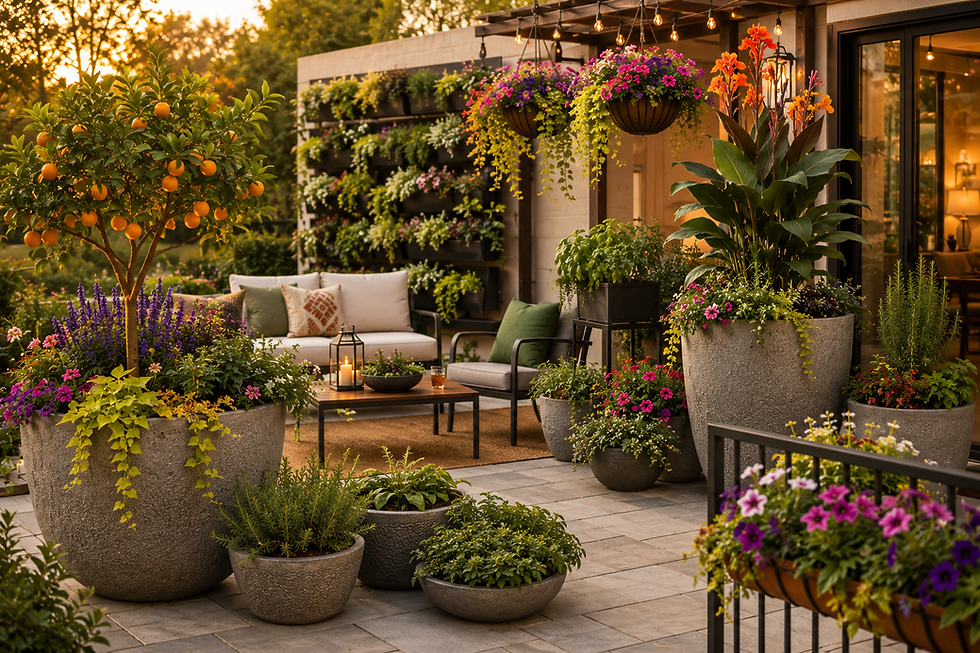
The best container garden ideas for 2026 share three principles: grow vertically to maximize space, use fewer but larger statement planters instead of many small ones, and build each container around the thriller-filler-spiller method: a tall focal plant, rounded middle plants, and trailing plants that spill over the edge. Whether you have a full backyard, a compact patio, or a single balcony railing, the ideas below turn containers into the structure of the space rather than an afterthought.
Container gardening is having a genuine design moment. As outdoor spaces become true extensions of the home, the humble pot has been reinvented: oversized, layered, and purposeful. This guide collects 25 container garden ideas that actually work, organized from foundational design techniques through statement pieces, vertical solutions, color schemes, purpose-driven planting, and finishing touches. Each includes the practical detail and the right products to make it happen. Austram has manufactured garden products since 1981, and these are the ideas we see delivering the biggest impact.
Start Here: The Thriller-Filler-Spiller Method

Before any specific idea, one design principle underlies nearly every great container: thriller, filler, spiller. Originated by garden writer Steve Silk, a former contributing editor at Fine Gardening, it remains the most reliable formula for a balanced, professional-looking container.
The thriller is the tall focal plant that provides height and drama, such as an ornamental grass, a spike, a canna, or a dramatic foliage plant. Place it in the center of a container viewed from all sides, or toward the back of one viewed from the front.
The filler is the rounded, mounding plant that fills the middle and adds fullness and color, such as petunias, begonias, salvia, or coleus. Fine Gardening recommends choosing fillers roughly one-third to two-thirds the size of the thriller for balanced scale.
The spiller is the trailing plant that cascades over the edge, softening the container and adding movement. "The spiller in the thriller, filler, spiller recipe is what gives a container that lush, finished, and intentional quality," says McCauley Adams, principal designer at Ramble on Rose Garden Design.
On proportions, garden designer Daniel McCurry of Father Nature Landscapes offers a practical benchmark: for a 16-inch pot, one thriller, five fillers, and seven spillers make a full, professional-looking mix. The formula is a guideline rather than a strict rule; a modern planter might feature a single dramatic thriller alone, but for beginners, it removes the guesswork.
The one non-negotiable across every idea in this guide: combine plants with the same light and water needs. As McCurry puts it, "plant right for your light." Mixing sun-lovers and shade-lovers in the same container is the most common cause of a display that fails by midseason.
Statement and Focal-Point Ideas

1. Go Big with One Oversized Statement Planter
The clearest container trend of 2026 is scale. Designers are choosing one oversized statement planter over a scatter of small pots; it reads as intentional, luxe, and architectural. A single large container planted with one dramatic specimen becomes the focal point of an entire patio. Austram's Vizcaya Square Planter (12"x12"x18") and Vizcaya Vase (11"x6"x20") deliver this height and presence with a premium stone-composite finish that stays outdoors year-round.
2. Layer Pots of Different Heights in the Same Style
The secret to a curated, professional look is layering: group three or more containers of varying heights but with a consistent style and finish. This creates a cascading, mini-landscape effect on a patio or beside an entry. The Vizcaya Collection makes this easy: the Pot, Planter, Square Planter, and Vase share one design language across different heights, so a grouping looks cohesive rather than accidental.
3. Anchor the Space with an Architectural Tree or Citrus
One of the most sophisticated 2026 looks is a single ornamental tree or citrus in a supersized container as the garden's central focal point. The Mediterranean-modern potted citrus has become something of a status symbol in garden design. Choose a container with the depth and stability for a small tree. A large stone-composite planter anchors a top-heavy specimen without the tipping risk of lightweight plastic.
4. Cluster Containers in Odd Numbers
Groupings of three or five containers read as more natural and balanced than pairs or even numbers, a principle borrowed from classic floral design. Vary the heights, keep the finishes related, and let the tallest anchor the arrangement. This is the fastest way to make a bare corner of a deck or patio feel deliberately composed.
Vertical and Space-Saving Ideas

5. Build a Living Wall with Wall-Mounted Planters
Vertical growing turns unused wall and fence space into a lush green backdrop, the single most effective move for a small patio. Austram's Venetian Wall Planter (14" and 16") and Venetian Wall Trough (24", 30", 36") mount flush to a wall, while the Woven Coco Wall Planter (available in 2-, 3-, and 4-pocket versions) creates a soft, textured living wall of trailing greenery and herbs.
6. Add Height with a Tiered Plant Stand
A tiered stand creates instant vertical layering in a compact footprint, ideal for a corner or beside a doorway. Austram's Alexis Tall Stand with Coco Basket (10" and 12") combines a raised stand with a coco-lined basket, adding a vertical accent where floor space is tight but height is free.
7. Hang Baskets at Varied Heights
A cluster of hanging baskets suspended at staggered heights draws the eye upward and creates a layered curtain of color and cascade. Mix the Cone Hanging Basket w/ Wire Hanger (12" and 14"), the Spanish Hanging Basket (12" and 14"), and the Queen Anne Parasol Hanging Planter for varied silhouettes. Hang them from a pergola beam, a wall on Euro Brackets (12", 18", 24"), or a Shepherd Hook where there's no overhead structure.
8. Make an Obelisk the Vertical Centerpiece
A climbing plant on an obelisk delivers dramatic height for very little floor space and doubles as living privacy. Austram's Exuma Obelisk (48" and 54" Matte Black) and Harbor Obelisk (48" and 54" Matte Bronze) support sweet peas, morning glory, clematis, or Mandevilla rising from a container below, a strong "thriller" in structural form.
9. Train Vining Plants Up a Coco Pole
For tropical vining plants that summer outdoors, pothos, philodendron, and monstera, a natural climbing pole lets them grow upward instead of sprawling. Austram's Coco Poles (24" through 60") give aerial roots a breathable, moisture-retaining substrate to grip and stack in height as the plant grows.
10. Turn a Railing into a Planting Ledge
Balcony and deck railings are prime unused growing space. Compact planters lined along a railing, or wall planters mounted to the railing uprights, add a productive band of herbs or trailing flowers without touching the floor. Austram's ProGro Petite planters, Hexagon, Round, Square, and Rectangular, are sized specifically for this kind of tight, linear placement.
Color and Style Ideas

11. Commit to a Jewel-Tone Scheme
The defining color story of 2026 containers is jewel tones: deep burgundy, plum, eggplant, and emerald green. Rather than sharp contrast, these rich colors pair with others in the same family for a cohesive, refined result, letting a single richly colored plant lead the whole arrangement. Dark-foliaged heucheras, inky salvias, and burnished coleus carry this palette beautifully.
12. Size Up with Muted Neutral Planters
A designer trick worth knowing: muted, neutral planters carry less visual weight than bold or dark pots, which means you can size up without the container overwhelming the space. A larger neutral planter supports fuller, more impactful planting while reading as calm and understated. Austram's Anchor Grey Vizcaya finish is built for exactly this approach.
13. Try a Tonal, Single-Color Planting
A container planted in shades of a single color, all whites, all purples, all silvers, reads as sophisticated and intentional. Tonal plantings are especially effective in a small space, where a riot of mixed color can feel chaotic. Use foliage as well as flowers to build depth within one color family.
14. Contrast Your Container Against the Backdrop
A frequently overlooked design rule: your container and its planting should contrast with the hardscape behind them. Against a red brick wall, a white or pink display stands out where red geraniums would disappear; against a pale fence, a deep purple or bronze container reads crisply. Consider the wall, siding, or fence color before choosing a container finish; the Vizcaya Collection's Anchor Grey, Rust, and Black covers most backdrops.
Purpose-Driven Container Ideas

15. Plant an Edimental "Modern Meadow" Container
One of the biggest 2026 shifts is toward "edimentals," edible plants chosen for ornamental value, too. Purple basil, rainbow chard, trailing cherry tomatoes, and climbing beans mix beauty with harvest in a single container. Trailing cherry tomatoes make an excellent spiller; purple basil or bronze fennel works as a filler. The "Modern Meadow" aesthetic built on this mix is one of the year's defining container looks.
16. Build a Container for Pollinators
Containers increasingly pull double duty, beautiful and ecologically useful. A pollinator container planted with salvia, agastache, lavender, and compact milkweed feeds bees and butterflies while looking full and vibrant. As Monrovia notes, homeowners want plants that "work hard, behave well, and still feel special."
For a complete guide to pollinator planting, see our dedicated resource:
17. Keep a Kitchen Herb Container by the Door
The most-used container garden is a compact herb planter within arm's reach of the kitchen. Basil, thyme, parsley, chives, and mint (contained on its own to prevent spreading) in a Petite planter on a sunny step or railing delivers fresh flavor all season. Keep the container within about 20 feet of the door; the closer it is, the more you'll actually use it.
18. Grow a Compact Vegetable Container
Small-space food growing is booming. A deep container supports cherry tomatoes, peppers, or bush beans; a wide, shallow one suits lettuce and salad greens. Match the container depth to the crop: deep-rooted vegetables need at least 12 inches, and tomatoes prefer a full 18.
Our pot-size guide covers the specifics for each crop.
Atmosphere and Finishing Touches

19. Pair Hanging Baskets with String Lights
There's something about warm string lights and trailing plants that turns a balcony into an evening retreat. Hang baskets to frame a wall or railing, then layer in warm-toned string lights overhead. The combination of cascading greenery and golden light makes even a tiny space feel like a destination after dark.
20. Add a Water Feature as a Living Focal Point
Garden fountains and water features are making a strong comeback in 2026; the sound and movement add a calm that's disproportionate to the space they occupy. Austram's Abaco Bird Bath (made from the same freeze-resistant stone-composite as the Vizcaya Collection) and the Solar Bird Bath Fountain (fully solar, no wiring) bring water, birds, and pollinators onto a patio without plumbing.
21. Make the Whole Garden Mobile
A rolling plant caddy transforms how a small container garden works. Austram's Lotus Plant Caddy (12" and 14") supports up to 200 pounds on wheels, protects flooring, and lets you move heavy planted pots to follow the sun or reconfigure the space on demand. Roll containers together to form a temporary privacy creen, then move them back, a genuinely different way to use a small patio, and ideal for renters.
22. Upcycle an Unexpected Container
Sustainable, characterful containers are a 2026 favorite: repurposed vintage crates, galvanized buckets, colanders, or wooden drawers make charming one-of-a-kind planters. The only requirements are drainage (drill holes as needed) and a liner to hold soil and moisture. A coco fiber liner turns almost any open vessel into a functional planter.
23. Line a Wire Basket for the Natural Look
Open-wire baskets and coco-lined containers deliver that soft, spilling, cottage-garden look that reads as effortless. A quality coco fiber liner is what makes it work; it holds soil and moisture while letting the planting cascade naturally over the rim. Austram's ProGro liners and the Coco Moss Roll (2'x36' and 3'x36') provide the natural moss-effect finish behind this style.
24. Create a Self-Contained Foliage Bowl
A single low, wide bowl planted entirely with foliage, snake plant, ornamental grasses, and tucked succulents reads like a living centerpiece rather than a pot. Placed near natural light, one well-composed bowl proves you don't need many containers when one arrangement is done thoughtfully. This is an ideal low-maintenance option for a table or ledge.
25. Frame an Entry with Matched Planters
A matched pair of planters flanking a front door or gate is a timeless, high-impact idea that makes a home feel considered and welcoming. Choose a structural, low-care planting: clipped boxwood, a compact evergreen, or an ornamental grass for a look that holds up for months. The stability and year-round finish of stone-composite planters suit this permanent, front-facing role.
The Practical Foundation: Drainage and Liners
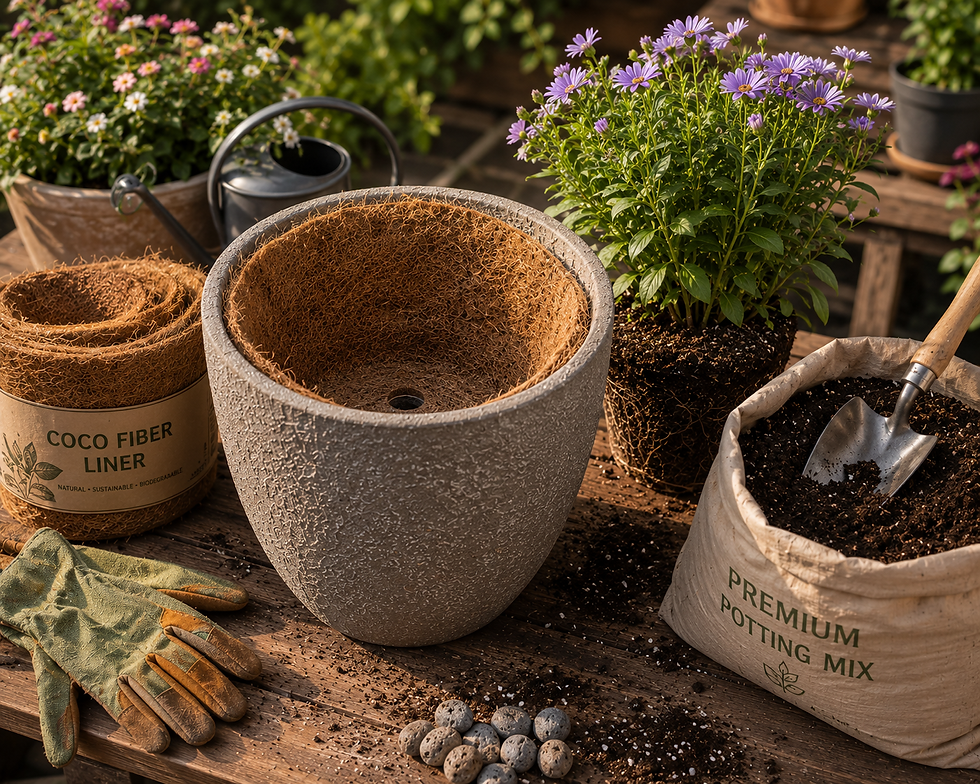
Every idea above depends on two fundamentals: drainage and moisture management. A container without drainage holes will waterlog and rot roots, no matter how beautiful the planting. And a container that dries out unevenly, especially a hanging basket or wall planter in full sun, will look tired by midsummer.
This is where liners earn their place. Austram's ProGro Coco Fiber Liners are made from natural coconut coir: they distribute moisture evenly across the root zone, drain excess water to prevent rot, and hold their structure for up to two full growing seasons in the Premium tier without the "bird's nest effect" that breaks down cheaper liners mid-season. For hanging and wall displays especially, the liner is the difference between a container that thrives all season and one that struggles.
Common Container Garden Mistakes to Avoid

Mixing plants with different needs. The number-one cause of container failure. Pairing sun-lovers with shade-lovers, or drought-tolerant plants with thirsty ones, guarantees that something struggles. Group by light and water needs.
Choosing a container that's too small. Small containers dry out fast and restrict roots. When in doubt, size up: a larger container is more forgiving and supports fuller planting.
Skipping drainage. No drainage holes mean waterlogged roots and rot. Every container needs drainage, and no gravel layer at the base that raises the waterlogged zone rather than fixing it.
Underwatering in summer. Containers, especially small ones and hanging baskets, can need daily watering in peak heat. Check the top inch of soil; water when it's dry.
Overcrowding on day one. Plants that look sparse at planting will fill in. Cramming too many in reduces airflow and invites disease. Trust the spacing.
Frequently Asked Questions
What is the thriller-filler-spiller method in container gardening?
Thriller-filler-spiller is the classic container design formula, originated by garden writer Steve Silk of Fine Gardening. The "thriller" is a tall focal plant for height and drama, placed in the center or back; the "filler" is a rounded, mounding plant that adds fullness and color in the middle; and the "spiller" is a trailing plant that cascades over the edge to soften the container and add movement.
It's a guideline, not a strict rule. For a 16-inch pot, designer Daniel McCurry suggests one thriller, five fillers, and seven spillers for a full look. The key requirement is that all plants in a container share the same light and water needs
What are the best container garden ideas for a small space?
For small spaces, grow vertically: use wall-mounted planters, hanging baskets, tiered stands, and climbing plants on an obelisk to free up floor area. Choose one oversized statement planter rather than many small pots, and use a rolling plant caddy so you can move containers to follow the sun or reconfigure the space.
Compact planters sized for railings and ledges, a single foliage bowl as a centerpiece, and a matched pair of planters framing an entry all work well in tight footprints. The goal is to build upward and commit to fewer, higher-impact containers rather than crowding the floor.
What container garden colors are trending in 2026?
Jewel tones lead 2026 container design: deep burgundy, plum, eggplant, and emerald green, paired within the same color family for a cohesive, refined look rather than sharp contrast. This lets a single richly colored plant anchor an entire arrangement.
Muted, neutral planters are also strong, precisely because they carry less visual weight and let you size up the container without overwhelming the space. Whatever palette you choose, contrast the container and planting against the wall or fence behind it so the display stands out rather than blending in.
How many plants should go in a container garden?
It depends on container size and plant vigor, but the thriller-filler-spiller framework gives a reliable starting point: for a 16-inch pot, roughly one thriller, five fillers, and seven spillers create a full, professional look. Larger containers support more; smaller ones need fewer.
Avoid overcrowding at planting time. Plants that look sparse on day one will fill in over a few weeks. Too many plants reduce airflow and invite disease. Always match every plant in a container to the same light and water requirements.
Do container gardens need special soil and liners?
Yes. Use a quality container potting mix rather than garden soil, which compacts and drains poorly in a pot. For hanging baskets and wall planters, a coco fiber liner is important; it retains moisture evenly, supports drainage, and prevents the fast, uneven drying that makes these displays fail in summer heat.
Austram's ProGro Coco Fiber Liners hold their structure for up to two full growing seasons in the Premium tier. Every container also needs drainage holes; do not add a gravel layer at the base, which actually raises the waterlogged zone toward the roots rather than improving drainage.
What plants work best in container gardens for beginners?
Reliable beginner container plants include ornamental grasses and coleus as thrillers; petunias, salvia, and begonias as fillers; and sweet potato vine, bacopa, and trailing verbena as spillers. Herbs like basil, thyme, and parsley are forgiving and useful, and succulents are nearly foolproof for sunny, low-water spots.
The most important beginner principle is matching plants to your light. A sun-loving plant will fail in shade, and a shade plant will scorch in full sun. Read the plant tag for light and water needs, and group only plants with matching requirements in the same container.
Final Thoughts on Container Garden Ideas for 2026

The through-line across every idea here is intentionality. In 2026, containers aren't filler; they're the structure of the space, chosen for scale, grouped with purpose, and built on the reliable foundation of thriller, filler, and spiller. Whether you start with one oversized statement planter, a vertical living wall, or a single herb pot by the kitchen door, the fundamentals hold: match plants to your light, give them drainage and a good liner, and choose fewer, better containers over many crowded ones.
Start with one idea that fits your space, get it right, and expand from there. A great container garden is never finished; it's a living composition you refine every season.
For more on this year's outdoor design direction:


Comments