
What is the Best Liner to Use for Hanging Baskets?
Updated: Jul 15
Coco fiber liners are the best choice for most hanging baskets. They balance moisture retention, drainage, and root airflow better than moss, plastic, or fabric alternatives, and they hold their structure across a full growing season without breaking down or losing shape. For most plants, most climates, and most gardeners, coco fiber is the right answer.

Not all coco liners perform the same way, though. There are meaningful differences in construction quality, liner type, and the conditions they suit best. This guide covers everything you need to choose correctly, including how liner construction affects plant health, which liner works best for your climate, and how to get the maximum life out of your liner across the season.
Why is the liner the Most Important Decision in a Hanging Basket?
Most gardeners focus on the basket frame, the plants, and the potting mix. The liner is treated as an afterthought. That's backwards.
The liner determines how water moves through the basket, how much oxygen reaches the root zone, how quickly the basket dries out between waterings, and how long the entire setup holds together. A high-quality plant in a poor liner will underperform. The same plant in the right liner will thrive with less intervention.
Hanging baskets are more demanding than ground-level containers. Airflow reaches all sides of the basket, which accelerates moisture loss, particularly in warm or windy conditions. The liner has to compensate for that by maintaining consistent moisture without trapping water around the roots. That balance is what separates a good liner from a poor one.
Coco Fiber Liners: Why They Outperform the Alternatives

Coco fiber, also called coconut coir, is a natural material made from coconut husks and is considered one of the Best Liners to use for Hanging Baskets. It is widely used across commercial horticulture because it holds a significant amount of water while remaining porous enough to drain excess moisture and allow air to circulate to the root zone.
Quality coco fiber can absorb and retain up to eight times its own weight in water, releasing it gradually to plant roots rather than allowing it to drain away in a single watering cycle. This is precisely what makes coco fiber so effective in hanging baskets, where moisture loss is the primary challenge.
What makes quality coco fiber particularly effective for plant health is its natural chemistry. Coconut coir has a near-neutral pH of 6.0–6.7, which suits the majority of flowering and foliage plants without any amendment. It also contains small natural amounts of phosphorus and potassium, trace nutrients that support root development. Coir also has natural antifungal properties that help discourage fungal disease in the root zone. And critically, coconut coir fiber is naturally sterile. Unlike garden soil or reused moss, coir does not harbor or transmit soil-borne pathogens, making it a consistently safe growing environment across multiple seasons of use.
Austram has been working with coconut coir since 1981, when the company introduced Coco Moss to the United States market, sourcing directly from the Philippines. That depth of experience informs the ProGro line, Austram's professional-grade coco fiber liner designed for retail garden centers and commercial growing programs.
ProGro liners are densely woven from premium, sustainably sourced coconut coir with no glue or additives. This matters in practice. Many generic coco liners on the market use latex binders to hold fibers together. Over the course of a season, those binders break down, the fibers separate and clump, and the liner develops what growers call the "bird's nest effect", uneven pockets that restrict root growth and reduce plant stability. ProGro's construction avoids this entirely. The liner maintains density and structure throughout the growing season and through a second full season with proper care.
Absorbs and retains up to 8x its weight in water |
Near-neutral pH (6.0–6.7) — suits most flowering and foliage plants with no amendment |
Natural antifungal properties — discourage fungal disease at the root zone |
Naturally sterile — does not harbor or transmit soil-borne pathogens |
Contains trace phosphorus and potassium to support root development |
No glue or additives — prevents the bird's nest effect that degrades cheaper liners |
Two full growing seasons of performance from a single liner |
Comparing All Four Liner Types
Liner Type | Drainage | Moisture Retention | Durability | Best For |
Coco Fiber — ProGro Premium | Excellent | Balanced | 2 full seasons | Most plants, most climates |
Coco Fiber — Standard | Excellent | Balanced | ~1 season | Budget-conscious buyers |
Sphagnum Moss | Moderate | Very High | ~1 season | Cool, humid climates |
Plastic | Poor | Very High | Multi-season | Hot, arid climates only |
Felt / Fabric | Good | Moderate | 2–3 seasons | Shaded positions, eco buyers |
Moss Liners
Sphagnum moss liners have been used in hanging baskets for generations. They hold a large amount of moisture and create a soft, traditional appearance. In cool, humid climates with consistent rainfall, moss liners perform adequately.
The limitations show up in warmer or drier conditions. Moss tends to dry unevenly; the surface dries while the interior stays saturated, creating inconsistent moisture that stresses plant roots. Moss also compacts with repeated watering and handling, which reduces airflow over time. Unlike coco coir, moss is slightly acidic and lacks the antifungal properties that protect hanging basket root zones.
Plastic Liners
Plastic liners retain moisture longer than any other option. In extremely hot, dry, or windy climates where hanging baskets lose water within hours, plastic can extend the time between waterings. That is its only real advantage. The trade-off is significant: plastic eliminates the root airflow that prevents fungal disease and oxygen deprivation. For most climates and most plants, the risks outweigh the benefits.
Some gardeners place a thin layer of plastic inside a coco liner to slow moisture loss without eliminating airflow. This targeted approach works for water-sensitive plants in high-heat conditions, provided drainage at the base is not sealed.
Felt / Fabric Liners
Felt liners, typically made from recycled polyester or natural jute, are breathable, lightweight, and easier to trim and fit than coco or moss. They do not offer the same moisture retention as coco fiber and tend to look less natural in decorative settings. They are a reasonable choice for shaded positions where heat-driven moisture loss is less of a factor, and for gardeners who prioritize a reusable, budget-friendly option. Felt does not provide the root zone chemistry benefits, pH neutrality, antifungal properties, and trace nutrients that coco coir delivers naturally.
ProGro Fiber Lite vs. ProGro Premium: Choosing the Best Liners to Use for Hanging Baskets
Austram produces two tiers of coco fiber liner for different buyer needs.
ProGro Fiber Lite uses thinner coir construction with a latex binder. It is the most economical option, available in larger case quantities, and designed for production growers who prioritize cost efficiency over multi-season durability. Fiber Lite has an approximate one-year lifespan.
ProGro Premium uses thicker coir with no glue or additives. It is densely woven, maintains structure through two full growing seasons, and is priced approximately 20–30% above Fiber Lite. It is the right choice for retail installation
Feature | ProGro Fiber Lite | ProGro Premium |
Construction | Thinner coir, latex binder | Thicker coir, no glue or additives |
Lifespan | ~1 growing season | ~2 full growing seasons |
Bird's nest risk | Present as a binder degrades | Prevented by dense construction |
Additives | Contains latex binder | None — 100% natural coir |
Best for | Production growers | Retail, long-term installations |
Price | More economical | ~20–30% higher |
Choosing the Right Liner for Your Climate

Climate is the variable most gardeners underestimate when choosing a liner. The same coco liner performs differently in different environments.
Hot, dry climates (Southwest US, full-sun locations):
Baskets lose water fast. ProGro Premium's dense construction retains moisture longer than thinner liners. Consider pairing with a thin plastic layer inside the coco liner to reduce evaporation, but always leave the base unobstructed for drainage. For an additional moisture boost, mix perlite or water-absorbing polymer crystals into the potting mix before planting; both slow the rate at which the basket dries out between waterings without restricting the drainage the coco liner provides. Water daily during peak summer heat.
Humid climates (Southeast US, Pacific Northwest):
Moisture retention is less of a concern; drainage and airflow become more important. Coco fiber's natural drainage properties are an advantage here; moss would stay too wet in high-humidity conditions, increasing root rot risk. Standard watering schedules are usually sufficient.
Temperate/variable climates (Midwest, Mid-Atlantic):
Standard ProGro Premium liners perform consistently across the season. The combination of moisture retention in dry spells and drainage during rain makes coco fiber the most forgiving option for variable conditions.
Coastal gardens:
Salt air accelerates the breakdown of natural fibers. ProGro Premium's denser construction holds up longer than thinner coco liners in salt-exposed environments. Rinse baskets periodically to reduce salt accumulation on the fibers.
How to Size a Coco Liner for Your Basket
Liner sizing is straightforward but often done wrong, resulting in gaps, soil loss, and poor plant performance.
The liner diameter should match the basket's measured interior diameter, not the outer rim. Most wire baskets are measured by their outer diameter, so a "14-inch basket" typically needs a liner sized for the interior, usually 13 to 13.5 inches. When in doubt, size up slightly rather than down; a liner with a small overlap at the rim is preferable to one with gaps at the sides.
For depth: the liner should reach the full depth of the basket with no exposed wire at the base. A liner that doesn't reach the bottom creates a gap where soil and moisture escape.
Basket Size | Liner Size | Typical Use |
10–11 inches | 10-inch liner | Herbs, compact trailing annuals |
12–13 inches | 12-inch liner | Mixed flowering baskets |
14–15 inches | 14-inch liner | Larger trailing plants |
16–20 inches | 16–20-inch liner | Tropical, statement, commercial displays |
Preformed liners are molded to fit specific frame sizes and install faster than flat liners, which require manual shaping. For high-volume commercial installations, preformed is the more efficient choice.
How to Install a Coco Fiber Liner Correctly
Installation quality directly affects performance. A liner that isn't properly seated will shift, create gaps, and allow soil loss regardless of liner quality.
Match liner diameter to basket interior, not outer rim. The liner should reach the full depth of the basket with no exposed wire at the base. Select the correct size.
Before adding soil, soak the liner thoroughly. Dry coconut fiber initially repels water due to its density. Pre-moistening ensures even water absorption from the first watering onward. Pre-moisten the liner.
The liner should conform to the sides without gaps, particularly at the base where soil pressure is greatest. Press firmly into the frame.
Not garden soil, garden soil compacts in enclosed spaces and restricts the drainage that coco fiber is designed to provide. Use a quality container potting mix.
This allows for watering without overflow. Fill to within 1–2 inches of the top.
To settle the soil around root systems. Plant, then water thoroughly
In warm weather, check moisture daily. Hanging baskets lose water significantly faster than ground-level containers. Coco liners perform best when kept consistently moist rather than allowed to cycle through complete drying and re-wetting.
What Plants Grow Best in Coco-Lined Baskets
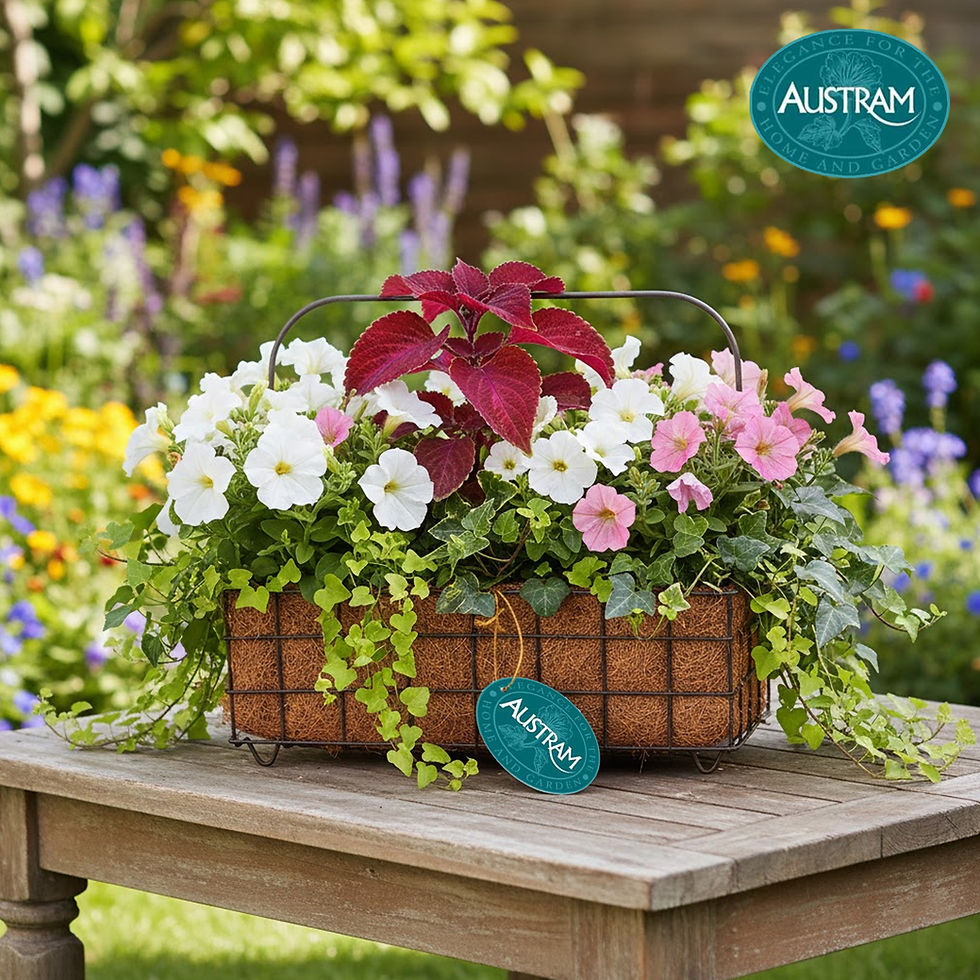
Plants that prefer consistent moisture with good drainage perform best in coco fiber. The strongest performers:
Trailing annuals: Petunias, lobelia, bacopa, and million bells are the standard choices for hanging basket displays. They flower prolifically, trail well, and handle the moisture fluctuations of hanging cultivation better than most other annuals.
Herbs: Basil, thyme, parsley, and trailing rosemary do well. Coco's breathable root conditions suit herbs that need good drainage but consistent moisture.
Flowering perennials: Fuchsia and impatiens perform particularly well, especially in shaded or partially shaded positions where heat stress is lower.
Ferns and foliage: Asparagus fern, ivy, and trailing pothos are strong choices for shadier positions where consistent moisture matters more than sun tolerance.
Avoid coco liners for plants with very low water requirements. Cacti, succulents, and drought-tolerant Mediterranean plants perform better in drier substrates where Coco's moisture retention would cause overwatering.
Seasonal Maintenance for Long-Lasting Baskets
Watering: During summer, baskets in full sun may need watering once or twice daily. Check by pressing a finger into the top inch of soil for water when it feels dry at that depth. Larger baskets retain moisture longer and reduce watering frequency.
Fertilizing: The limited soil volume in hanging baskets depletes nutrients faster than in-ground planting. Liquid fertilizer applied every one to two weeks sustains flowering and foliage through the season.
Deadheading: Removing spent flowers prevents energy diversion into seed production and extends flowering by weeks for trailing annuals. End-of-season liner care: After the final growing season, remove the liner from the frame, clear remaining soil, and dry it completely before storage. ProGro Premium liners stored correctly regularly return for a second full season. Spent liners can be composted at the end of their useful life. The natural coir breaks down and contributes organic matter to garden soil.
Frequently Asked Questions
What is the best thing to line hanging baskets with?
Coco fiber is the best liner for most hanging baskets. It balances moisture retention, drainage, and root airflow better than moss, plastic, or fabric, and quality versions like Austram's ProGro Premium last two full growing seasons without the structural breakdown that affects lower-quality liners. The specific advantage over moss is consistency: Coco fiber distributes moisture more evenly across the root zone and maintains its structure through repeated watering cycles. The advantage over plastic is airflow: Coco fiber creates breathable root conditions that significantly reduce fungal disease risk.
Are Coco liners better than moss liners?
For most applications, yes. Coco fiber provides better root airflow, longer lifespan, and more consistent moisture distribution than sphagnum moss. Moss retains more total moisture but dries unevenly, compacts with repeated watering, and typically deteriorates within one season. Moss is also slightly acidic, which can affect pH-sensitive plants. Coco fiber's near-neutral pH (6.0–6.7) suits a wider range of plants without amendment. The one scenario where moss holds an advantage is in cool, humid climates with high ambient moisture, where drainage matters less than moisture retention.
Can you reuse a coconut fiber liner?
Yes, if the liner is of quality construction and was properly cared for. ProGro Premium liners are specifically built for two full growing seasons of use. After the first season, remove the liner, clear spent soil, rinse if needed, and dry completely before off-season storage. Avoid leaving liners planted through winter in freeze-prone climates. Freeze-thaw cycles break down fiber faster than any other factor. Standard Coco liners and Fiber Lite are typically single-season products. Attempting to reuse them risks structural failure mid-season.
Does coconut fiber spread disease to plants?
No. Coconut coir fiber is naturally sterile; it does not harbor or transmit soil-borne pathogens. This is one of its practical advantages over reused moss or garden soil, both of which can introduce disease into a new planting. Coir also has natural antifungal properties that help discourage fungal development in the root zone, which is particularly valuable in the consistently moist environment of a hanging basket.
Should hanging baskets be lined with plastic?
Only in specific situations, such as very hot or arid climates, high-wind locations, or for particularly water-sensitive plants. Fully sealed plastic eliminates root airflow and increases waterlogging and fungal disease risk. If you use plastic, pair it inside a coco liner and always leave the base unsealed so drainage is not blocked. For most climates and most plants, a quality coco liner alone is the better solution.
What can I use instead of a basket liner?
Burlap and landscape fabric are the most functional alternatives. Burlap is biodegradable and breathable, the closest functional substitute for coconut fiber as an emergency replacement. Landscape fabric holds soil well and can last several seasons. Neither provides the moisture retention, natural pH balance, antifungal properties, or trace nutrients that coconut coir delivers. For any installation that needs to perform consistently across a full season, a purpose-made coco liner is the right investment.
Do you plant directly into a coco liner?
Yes. Add container potting mix directly onto the liner and plant into the soil normally. Coco fiber does not interfere with root growth, has a breathable, moisture-retentive structure, and actively improves root conditions compared to solid plastic inserts. Use a container potting mix rather than garden soil, which compacts in enclosed spaces and restricts the drainage coco fiber is engineered to provide.
How do I know when to replace my Coco liner?
Replace the liner when it shows visible fiber separation, loss of shape, or persistent gaps between the liner and basket frame. Structural breakdown usually begins with thinning at the base, where water pressure and gravity create the most stress. ProGro Premium's dense construction delays this significantly compared to standard liners. At the end of each season, inspect the liner before storing it. If the fiber holds its shape and has no tears or thinning, it's worth storing for a second season.
ProGro liners are available through Austram's authorized wholesale distribution network nationwide. |
Austram operates a wholesale-only model. Direct consumer sales are not available. |
Garden centers, nurseries, and landscape professionals: |
Find a Regional Distributor distributors ProGro Coco Fiber Liner


Comments